
Throckmorton Projected and Actual Release
TDCJ defines a Projected Release Date as the date its Classification and Records Office calculates a person should be released if parole does not occur sooner. It is forward-looking. The field can move, and it is not an actual-release certificate. A release history or physical custodian's departure record answers what eventually happened.
Scheduled is not actual. A projected date can change before release, and passing that date does not prove the person left custody.
A pretrial detainee usually lacks a sentence-based date. Release may instead follow bond, dismissal, a court order, a plea, or transfer. A person serving a county sentence may have a calculation based on the judgment, time already credited, and the jail's lawful practices. Neither situation should be assigned a TDCJ projection unless the person is actually in state prison.
Throckmorton County does not publish an operating jail roster. The Sheriff may route a person to Stephens County or another custodian. A Stephens status marked RELEASED shows departure from that jail, but it does not display the date, time, reason, or destination.
Find Throckmorton Projected Release Dates
The correct route depends on custody. Begin with the Throckmorton Sheriff to identify the actual holding agency. The state portal is useful only after a TDCJ transfer, and its guidance says public results cover people currently incarcerated in TDCJ.
- Identify the custodian. Ask the Throckmorton County Sheriff where the person was booked or transported.
- For county custody, get the judgment. Request the sentence, commitment, bond order, or release order from the proper court and ask the jail for its calculation.
- For state custody, use an identifier. Search the TDCJ inmate portal by TDCJ number or SID, or exact last name and first initial.
- Read the field literally. Record the Projected Release Date, location, identifiers, and access date. Do not relabel it as release.
- Verify near the date. Contact TDCJ or the physical jail because court orders, holds, credits, and parole action may intervene.
TDCJ's free email route can provide projected-release information. Send the full name and seven-digit TDCJ number to pia@tdcj.texas.gov. Without that number, provide exact date of birth, or approximate age plus county of conviction. The general locator is 936-295-6371 or 800-535-0283 during published weekday business hours.
The official email instructions also describe conviction and incarceration information that can help distinguish similar names. For a durable history, submit a Public Information Act request for commitment, release, parole, mandatory-supervision, maximum-expiration, and discharge records.
The official TDCJ projected-date definition is visible at its definitions page. The captured page below supports the field's meaning and keeps a calculated date distinct from an actual Throckmorton County release event.
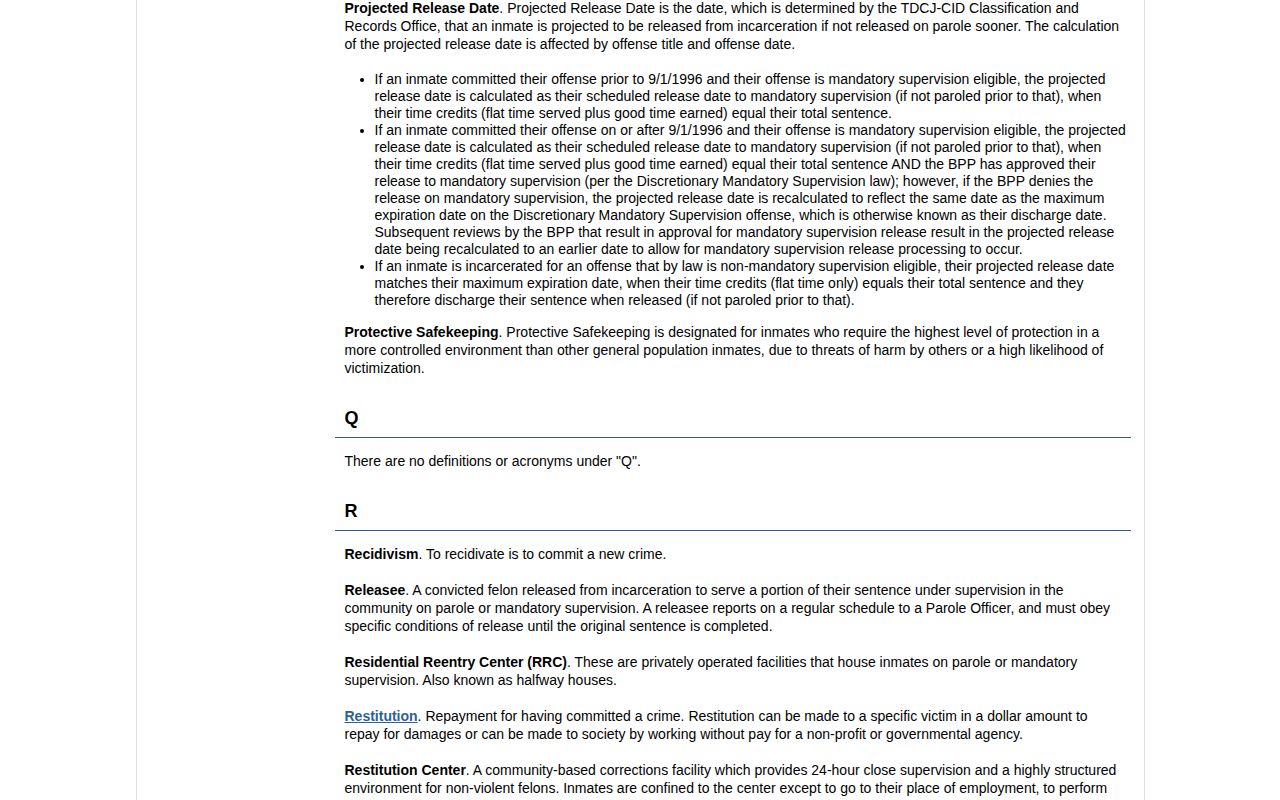
That definition should travel with any copied date. Without it, a forward-looking estimate can easily be mistaken for proof that release occurred.
Texas Good Time for Release
Texas Government Code section 498.003 governs good-conduct-time awards. Good time is an administrative credit tied to conduct and program participation. It is not calendar time, and it does not reduce every parole-eligibility calculation in the same way.
For a mandatory-supervision-eligible offense committed before September 1, 1996, TDCJ explains that projected release occurs when flat time plus good time equals the sentence. For an eligible later offense, that threshold is also subject to BPP approval. If BPP denies mandatory supervision, the projected date may recalculate to maximum expiration. A later approval can move it earlier.
Someone not eligible for mandatory supervision generally has a projected date at maximum expiration based on flat time unless parole occurs first. Chapters 498 and 508 must be read with the offense, offense date, sentence, and exclusions. A general formula cannot replace the agency calculation.
Note: Good time and calendar time are different, and neither a credit estimate nor a parole review date proves physical release.
Why Throckmorton Release Dates Change
A projection reflects the information and law applied at that point. TDCJ can recalculate when the sentence record, time-credit status, mandatory-supervision decision, or another legal event changes. County calculations can also change after a corrected judgment or new court order.
| Event | Possible effect | Best source |
|---|---|---|
| Sentence change or corrected credit | Moves the calculated date | Court and TDCJ or jail records |
| Good-time classification or forfeiture | Changes eligible credit where law permits | TDCJ Classification and Records |
| BPP parole action | May allow release or set later review | BPP and Parole Division |
| Mandatory-supervision denial | Can move projection to maximum expiration | BPP decision and TDCJ record |
| Detainer, hold, or transfer | May prevent community release | Departure and destination record |
| New court order | Can alter custody authority | Issuing court and physical jail |
A departure from Stephens County Jail can lead to TDCJ, another county, federal custody, or immigration custody. It is not enough to see a person leave the host roster. Ask for the destination and reconcile it with the receiving system.
Confirm Throckmorton Actual Release
After an expected date, ask the responsible custodian for the actual departure event. For a county booking, request the date, time, release type, authorization, and destination. For TDCJ, seek commitment and release history naming actual release, parole or mandatory supervision, maximum expiration, and final discharge.
The VINELink Check can alert to an agency-fed status change, but an alert may reflect departure or transfer. It should trigger a call to the reporting custodian. The TDCJ online search cannot serve as a released-person archive because it excludes former prisoners. A missing result alone proves nothing.
For parole prerelease review, use 844-512-0461. After a BPP vote, use the Parole Division release-status line at 512-406-5202. These channels describe different stages, and a favorable vote may include conditions that delay physical release.
Texas Has No 85 Percent Rule
Texas has no blanket rule requiring every person to serve 85 percent of a sentence. For certain serious offenses associated with the former “3g” category and now referenced through Code of Criminal Procedure article 42A.054, Government Code section 508.145(d) generally uses actual calendar time equal to half the sentence or 30 years, whichever is less. Good-conduct time is not counted in that calculation, and a two-calendar-year floor applies.
Other subsections, exclusions, offense dates, and sentence structures produce different results. Mandatory-supervision exclusions appear in section 508.149. The applicable law is tied to the conviction and offense date, so the serious-offense framework should not be applied to every Throckmorton County sentence.
This distinction explains why a projected date may move to maximum expiration after BPP denies mandatory supervision. The TDCJ calculation, the BPP decision, and the actual-release record each answer a separate question.
Throckmorton County Jail Calculations
A local sentence is not calculated from TDCJ's Projected Release Date field. It may involve judgment credit, time served, concurrent or consecutive terms, bond, a court order, or transfer. Obtain the signed judgment and ask the actual host jail to explain the date reflected in its record.
No official local weekend or holiday early-release policy was verified. No fixed release door or hour was published. If an expected date falls on a closed-court day, call the physical custodian instead of assuming early release or delay.
The regional arrangement matters. Throckmorton's Sheriff page does not identify 108 Pogue Street as an operating jail, and the Stephens agreement is space-available and nonexclusive. Confirm the current host before asking for a county-jail calculation.
For a reliable county calculation, collect the booking date, judgment date, sentence length, credit stated in the judgment, and any later order. Ask the host jail to identify which of those records it used. A bond amount on a vendor screen does not establish that bond caused release, and a RELEASED label does not reveal whether the person went home or entered another custody.
The court record and jail event answer related but distinct questions. A release order can authorize departure on one date while the physical jail records departure later. Preserve both dates instead of forcing them into a single timestamp. If transfer followed, the receiving agency's admission record completes the sequence.
A records request to Stephens should seek admission and departure times, release type, authorization, and destination. A request to Throckmorton Sheriff should seek its arrest and transport logs and the identity of the host jail. No published local calculation worksheet, special fee, or guaranteed response time was found.
When the expected date involves a court case, use the correct clerk. The County Clerk handles criminal matters within county jurisdiction, the District Clerk handles district felony matters, and the Justice of the Peace covers traffic and Class C matters. Request the docket, judgment, sentence, commitment, bond order, dismissal, or release order that fits the case. The date of legal authorization may precede the jail's physical departure time.
For a past TDCJ sentence, request actual release date and type, maximum-expiration or discharge date, parole or mandatory-supervision dates, and the related county, court, and offense identifiers. Ask for electronic copies and an itemized cost estimate. No special TDCJ discharge-record fee or release-history retention period was verified. A complete response is stronger than trying to infer release from a person disappearing from the current-only online portal.
Public Record Search
Sponsored Results